
The Structure and Properties of Water
-
The Structure and Properties of Water
-
Students mustMark as done

-
Students mustMark as done
-
Students mustMark as done
Intended Learning Outcomes (ILOs)
ILO1: Describe the molecular structure of water and explain its polarity.
ILO2: Explain how the polarity of water molecules gives rise to hydrogen bonds and contributes to water's unique properties.
ILO3: Identify and describe the thermal properties of water, including specific heat and heat of vaporization, and their importance in plant temperature regulation.
ILO4: Explain why water is considered an excellent solvent and its significance for nutrient transport in plants.
ILO5: Discuss the role of water’s cohesive properties and high tensile strength in water transport within the plant xylem.
ILO6: Describe the importance of water in plant physiology, particularly in nutrient uptake, temperature regulation, and structural integrity.
ILO7: Analyze and interpret experimental data related to water’s properties and their biological significance.
ILO8: Apply the understanding of water’s properties to real-world agricultural practices and crop management strategies.
ILO9: Design and conduct experiments to observe water’s properties such as cohesion, solvent capabilities, and thermal behavior.
ILO10: Engage in discussions and present findings on the significance of water in plant life, demonstrating the ability to apply theoretical knowledge to practical scenarios.
-
Students mustMark as done
Online Activities Plan
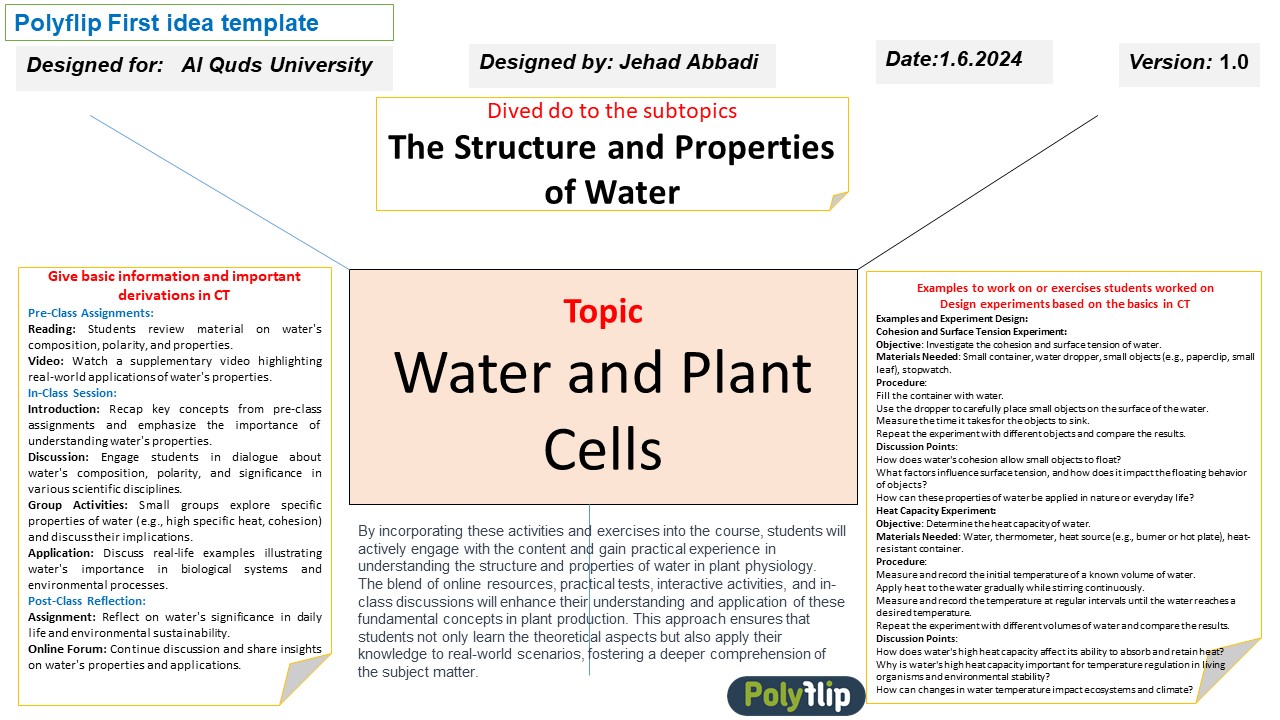
Pre-Class Assignments
Please complete the following pre-class activities:
-
Students mustMark as done
Watch Interactive video
This interactive video explores the vital role of water in plants, focusing on its unique properties and the importance of hydrogen bonding. You'll learn how water supports essential plant processes like photosynthesis and nutrient transport, building a strong foundation in plant physiology.
Instructions:
Watch the Video Actively: This video contains valuable information about the properties of water and its role in plants. Pay close attention as the concepts are explained with examples and visuals.
Engage with Interactive Questions: Throughout the video, you will encounter questions related to the content being presented.
- You must respond to each question correctly to proceed with the video.
- The questions are designed to assess your understanding of key points, so answer them carefully.
Performance Evaluation: Your responses to the questions will be evaluated by your instructor as part of your marks. Ensure that you provide accurate and thoughtful answers to demonstrate your understanding.
Take Notes: Keep a notebook handy to record key points from the video. This will help you answer the questions more effectively and serve as a reference for future study.
Complete the Video and Follow-Up Activity: After finishing the video, move on to the follow-up activity in Moodle to reinforce your learning.
Remember, this is an opportunity to actively engage with the material and deepen your understanding. If you have any questions or concerns, don’t hesitate to reach out to your instructor.
Good luck, and enjoy learning about the fascinating relationship between water and plants!
-
Watch video MP4Students mustMark as done
Watch the above video explaining water’s role in plants, highlighting its unique properties and the importance of hydrogen bonding.
Uploaded 29/08/24, 13:29 -
Students mustMark as done
-
Assignment
Reflect on the importance of water’s properties in plant life. Write a short essay discussing how these properties contribute to plant survival and growth. -
Students mustMark as done
Instructions for Assignment
Essay Topic: Reflect on the importance of water’s properties in plant life.Content: Write a short essay discussing how the unique properties of water -such as cohesion, adhesion, solvent capabilities, and thermal properties- contribute to plant survival and growth.
Structure: Ensure your essay is well-structured, with an introduction, body paragraphs that discuss each property in detail, and a conclusion summarizing the overall impact on plant physiology.
Length: Aim for 150-200 words.
Submission: Please submit your essay through the course's online portal by the deadline specified in the syllabus.
Evaluation: Your essay will be evaluated based on clarity, depth of reflection, understanding of water’s properties, and the connection to plant life.
-
Respond to Online Forum
Continue the discussion on water’s properties and their applications in plant life.Share insights and questions with classmates and instructors. -
-
Students mustMark as done
Quick MCQ: Self Assessment
-
Students mustMark as done
In-Class Activities Plan

-
Students mustMark as done
In Class Activities Plan
The instructions in this plan is for the teacher
-
Students mustMark as done
Step 1: Introduction (10 mins)
Recap key concepts from the pre-class assignments.Highlight the importance of water in plant physiology and its unique properties.Step 2: Interactive Discussion (20 mins):
Structure and Polarity of Water:
- Discuss the molecular structure of water and its polarity.
- Explain how water's polarity gives rise to hydrogen bonding.
Solvent Properties:
- Discuss why water is an excellent solvent due to its polarity.
- Provide examples of how this property is vital for nutrient transport in plants.
Thermal Properties:
- Explain how hydrogen bonding contributes to water’s high specific heat and heat of vaporization.
- Discuss the significance of these properties for temperature regulation in plants.
Cohesive Properties:
- Describe how hydrogen bonding results in water’s cohesion.
- Discuss the importance of cohesion in processes like capillary action in plants.
Tensile Strength:
- Define tensile strength and explain how water's high tensile strength supports water transport in plant xylem.
Step 3: Group Activities (30 mins):
Polarity and Solvent Properties:
- Experiment: Dissolve various solutes (e.g., salt, sugar) in water and observe the dissolution process.
- Discussion: Discuss how water's polarity facilitates the dissolution of different substances.
Thermal Properties:
- Experiment: Measure the temperature change when heating equal volumes of water and another liquid.
- Discussion: Explain the observed differences in temperature change based on hydrogen bonding.
Cohesion and Tensile Strength:
- Experiment: Demonstrate capillary action using narrow tubes and colored water.
- Discussion: Relate the height of water rise in tubes to cohesive properties and discuss the significance in plant water transport.
Step 4: Concept Application (20 mins):
- Present real-life examples, such as water’s role in nutrient uptake, temperature regulation, and maintaining structural integrity in plants.
- Discuss how understanding water’s properties can inform agricultural practices and improve crop management.
-