
PTUK Course (1): Solar Energy Systems (renewable energy)
The tariff systems used in energy systems (PRE-CLASS CONTENT)
Electricity Tariff:
Definition: The amount of money frame by the supplier for the supply of electrical energy to various types of consumers .
In other words, the tariff is the method of charging a consumer for consuming electric power. (The rate at which electrical energy is supplied to a consumer).
Its objective is recovery of costs and a suitable profit.
The tariff covers the total cost of producing and supplying electric energy plus a reasonable cost.
Electricity Tariff:
Its features:
- Proper return -Fairness -Attractive -Reasonable profit -Simple
It depends on:
- Type of load - Time at which load is required
- The power factor of the load - The amount of energy used
Types of Electricity Tariff Systems:
1- Single tariff ($/kWh) – no categories
2- Flat demand rate tariff depends on maximum demand of the load ($/kW).
3- Straight-line meter rate tariff . It depends on energy consumption but the charges for different types of consumption depends on the load and diversity factors of the load.
4- Block meter rate tariff. The per unit tariff of the individual block is fixed. The first few units of energy at a certain rate, the next at a slightly lower rate and the remaining unit at a very lower rate.
5- Sliding Scale (time scale)
6- Two-part tariff : The first part is the fixed charge and the second is the running charge. The fixed charge is because of the maximum demand and the second charge depends on the energy consumption by the load.
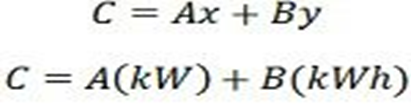
7- maximum demand tariff system – Total bill = A*Pact + B * E
8- Power factor tariff:
A - kVA maximum demand tariff 
B- kWh and kVarh tariff

C- Sliding Scale or Average power factor tariff
9- Three Part Tariff System
