
UCAS Course (2): AUTOMOTIVE Electrical and Electronic Systems
In this lesson we will cover the following topics:
- Starting system principles
- Starter motors and circuits
Engine starting requirements
An internal combustion engine requires the following criteria in order to start and continue running.
_ Combustible mixture.
_ Compression stroke.
_ A form of ignition.
_ The minimum starting speed (about 100 rev/min).
In order to produce the first three of these, the minimum starting speed must be achieved. This is where the electric starter comes in. The ability to reach this minimum speed is again dependent on a
number of factors.
_ Rated voltage of the starting system.
_ Lowest possible temperature at which it must still be possible to start the engine. This is known as the starting limit temperature.
_ Engine cranking resistance. In other words the torque required to crank the engine at its starting limit temperature (including the initial stalled torque).
_ Battery characteristics.
_ Voltage drop between the battery and the starter.
_ Starter-to-ring gear ratio.
_ Characteristics of the starter.
_ Minimum cranking speed of the engine at the starting limit temperature.
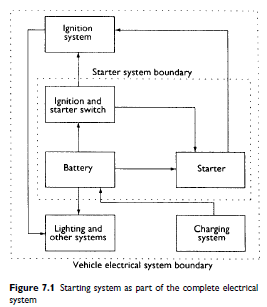
It is not possible to view the starter as an isolated component within the vehicle electrical system, as
Figure shows below. The battery in particular is of prime importance.
Another particularly important consideration in relation to engine starting requirements is the starting
limit temperature. The figure below shows how, as temperature decreases, starter torque also decreases and the
torque required to crank the engine to its minimum speed increases.
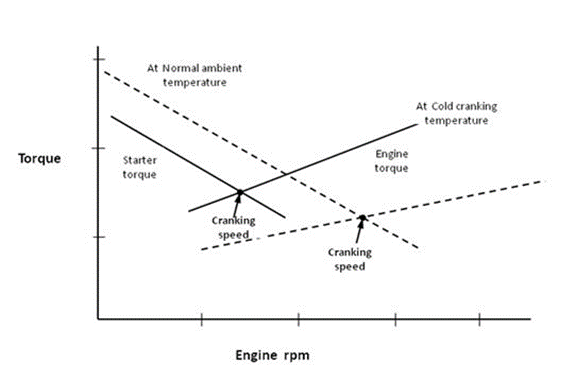
Typical starting limit temperatures are _18 °C to _25 ° C for passenger cars and _15 ° C to _20 °C for trucks and buses. Figures from starter manufacturers are normally quoted at both _20 ° C and _20 ° C.